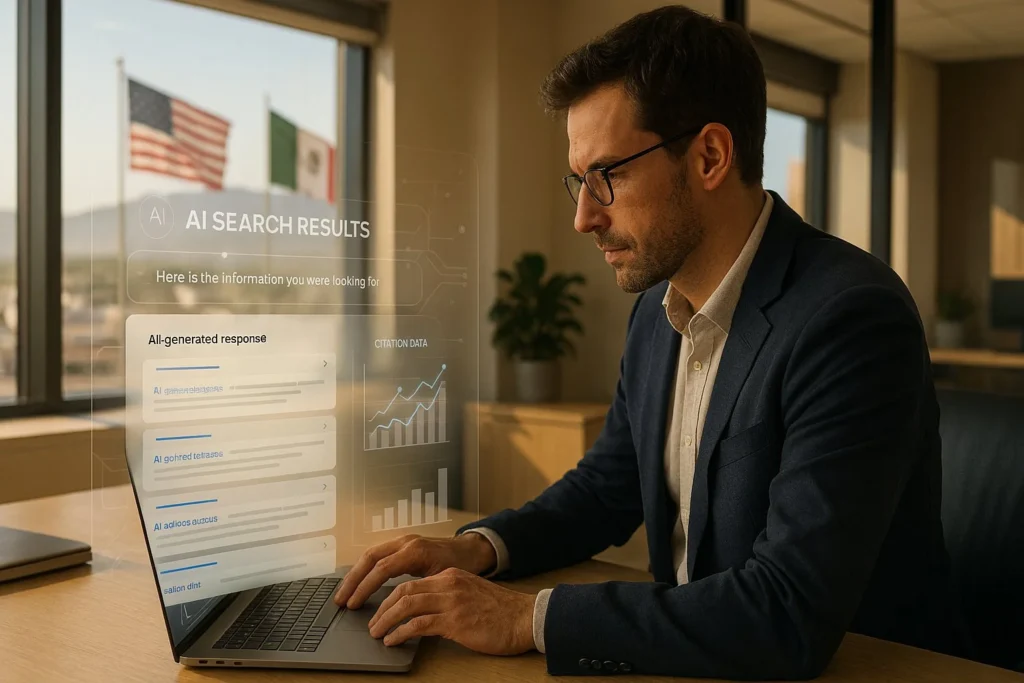
Search has changed. When someone types “best dermatologist near me” or “immigration attorney in Laredo” into Google today, they often get an AI-generated answer at the top of the page before they see a single website link. If your business is not the source of that answer, you are invisible to that searcher — even if you rank on page one.
That is what Answer Engine Optimization (AEO) is designed to fix. This breakdown covers what AEO is, how it differs from traditional SEO, why it matters specifically for service businesses near the US-Mexico border, and exactly what you need to do to show up in AI-generated answers.
AEO — Answer Engine Optimization — is the practice of structuring your content so AI-powered platforms can find it, understand it, and deliver it as the direct answer to a user’s question. It covers:
- How AI answer engines select and cite content
- How AEO differs from traditional SEO
- The structural changes that make content AI-ready
- Schema markup for AI visibility
- Why bilingual AEO gives border city businesses an edge
- How to track whether AI is citing your content
What Is AEO and Why Does It Matter in 2026
Traditional SEO gets your page into a list of search results. AEO gets your content selected as the answer itself — the text that appears before the list, inside the AI summary, or read aloud by a voice assistant.
The numbers explain why this matters now:
- Gartner predicts traditional search volume will drop 25% by 2026 as users shift to AI chatbots and virtual agents
- Frase reports ChatGPT now handles over 2 billion queries daily and AI-referred website sessions grew 527% year-over-year through mid-2025
- According to Search Engine Journal, Google AI Overviews now appear on over 21% of all searches — with informational queries triggering them at far higher rates
- Brands cited inside AI Overviews earn 35% more organic clicks than competitors not cited for the same query
For service businesses in border cities — where potential clients increasingly search in both English and Spanish — AEO is not a future trend. It is a current competitive gap. Most local competitors are not optimizing for AI citation. The businesses that start now will own that space before it gets crowded.
Want to understand how bilingual SEO and AEO work together? Read our breakdown of Bilingual SEO and AEO for service businesses near the US-Mexico border.
How AEO Differs From Traditional SEO
SEO and AEO are not competitors — they work together. But they measure different things and require different content decisions.
- SEO goal: rank in search results and earn clicks to your website
- AEO goal: be cited in AI-generated answers, even when the user never clicks
- SEO metric: rankings, traffic, click-through rate
- AEO metric: citation frequency, AI share of voice, brand mentions in AI responses
- SEO content: optimized for keywords and user intent
- AEO content: structured for machine extraction — clear definitions, direct answers, citable facts
The good news: most AEO best practices also improve your SEO performance. Well-structured, authoritative, data-backed content ranks better in Google and gets cited more frequently by AI engines. You are not choosing between the two — you are doing both at once when you do either well.
AEO is the logical evolution of SEO. The difference is that SEO gets you onto the list. AEO makes you the answer at the top of the page before the list even appears.
How AI Answer Engines Select Content
Understanding how AI engines work helps you write content they will actually cite. Here is the simplified version of what happens when someone asks an AI a question:
- The AI runs a web search — ChatGPT uses Google’s index, Perplexity uses its own crawler, Google AI Overviews pull from Google’s search index
- It retrieves the most relevant pages — pages that rank well in traditional search have a higher chance of being retrieved
- It extracts specific passages — not whole pages, but the most direct, clearly structured answers within those pages
- It synthesizes a response — combining information from multiple sources into one answer
- It cites its sources — linking back to the pages it extracted from
The critical insight from a CXL study of 100 AI Overview citations: 55% of citations came from the top 30% of a page. If your answer is buried three scrolls down, there is a better than even chance it will not get cited — even if your page ranks well.
The Structural Changes That Make Content AI-Ready
AEO is not about writing differently. It is about structuring what you already write so AI can extract it cleanly. Here is what that looks like in practice:
Answer First, Context Second
Every article and every section should lead with a direct answer in the first 50 to 70 words. State what the content covers immediately. AI engines favor content that front-loads the answer and builds context afterward — not content that spends three paragraphs setting up before getting to the point.
Short, Self-Contained Paragraphs
Keep paragraphs to 2 to 3 sentences. AI systems extract cleaner information from concise, scannable paragraphs than from dense blocks of text. Each paragraph should be able to stand alone as a citable unit.
FAQ Sections Built for Citation
FAQ sections are the highest-leverage AEO asset on any page. Each question-answer pair functions like a mini article — the AI can extract it directly without parsing the surrounding content. Write every FAQ answer with the direct answer in the first sentence, keep it between 75 and 150 words, and make it self-contained.
Numbered Lists and Structured Listicles
Numbered steps, bulleted lists, and comparison tables are directly extractable by AI without interpretation. When you write “5 ways to do X” or “3 things to check before Y,” you are creating pre-packaged AI citation targets.
Inline Data with Source Citations
AI engines favor content that cites its own sources. Add statistics with source citations every 150 to 200 words. This signals credibility to both AI and human readers — and increases the probability that your content passes real-time fact verification that some AI systems now perform.
Schema Markup for AI Visibility
Schema markup is code that tells AI systems exactly what your content is and how to interpret it. Three schema types matter most for AEO:
- Article / BlogPosting schema — tells AI engines this is an article with a specific author, publication date, and topic. Required for any blog post targeting AI citations.
- FAQPage schema — marks up your FAQ section so AI engines can directly extract question-answer pairs. One of the highest-impact AEO optimizations available.
- Speakable schema — marks sections of your content as suitable for voice assistant responses. Relevant for border city businesses where voice search usage is high.
If your site already uses Rank Math or Yoast, these schema types can be configured without writing code. The important thing is making sure they are set correctly on every post and page, not just the homepage.
Why Bilingual AEO Gives Border City Businesses a Specific Edge
Here is the opportunity most businesses near the US-Mexico border are missing entirely: Spanish-language AEO is almost completely uncontested.
When someone in Laredo asks Google or ChatGPT “¿cuál es el mejor dermatólogo cerca de mí?” or “¿cómo contratar un abogado de inmigración en McAllen?” — the AI is looking for a cited source. In English, it has thousands of options. In Spanish, it has almost none — especially for local, border-city-specific queries.
Businesses that build structured, properly marked-up Spanish content now are positioning themselves to own AI citations in Spanish-language search before any competitor gets there. That window will not stay open indefinitely.
The specific advantages for bilingual AEO in border cities:
- Spanish-language AI citations for local service queries are nearly uncontested in Laredo, McAllen, and Brownsville
- Bilingual content with hreflang signals both language versions to AI engines simultaneously
- Spanish FAQ sections targeting border-city-specific questions have almost no competition for AI citation
- Voice search in Spanish is growing — and voice queries are 7 to 10 words on average, which are exactly the queries most likely to trigger AI Overviews
How to Track Whether AI Is Citing Your Content
Traditional analytics do not show AI citations. Here is what to do instead:
- Manual sampling — run your target queries in ChatGPT, Perplexity, and Google AI Overviews monthly. Note whether your site appears as a cited source.
- Google Search Console — watch for queries with high impressions but low click-through rates. This often means your content is appearing in AI Overviews but users are getting the answer without clicking.
- Brand search monitoring — track branded search volume in GSC. Increases in branded searches after AI mentions suggest AI visibility is driving awareness even without direct clicks.
- Free tools — HubSpot’s AI Search Grader is a free starting point for measuring AEO performance. Semrush also has AI visibility tracking in its toolkit.
According to HubSpot’s State of Marketing report, 58% of marketers say visitors referred by AI tools convert at higher rates than traditional organic traffic. The clicks you do get from AI citations are higher-quality clicks — users who have already been pre-qualified by the AI summary before arriving at your site.
Common AEO Mistakes Service Businesses Make
- Burying the answer. If the direct answer to a question appears below the fold, AI engines are unlikely to cite it regardless of how good the rest of the content is.
- FAQs written for humans only. FAQ sections that use conversational language but lack direct, self-contained answers in the first sentence miss the AEO opportunity entirely.
- Missing schema markup. Content without Article and FAQPage schema is harder for AI engines to parse and categorize correctly.
- English-only content. For border city businesses, publishing only in English means you are invisible for all Spanish-language AI citations — which is currently the least competitive space in your market.
- No external citations. AI engines favor content that cites verifiable sources. Content with no external data references is treated as less authoritative.
- Outdated content. AI engines favor recent content over comprehensive older resources. A weaker article published last month often outranks a stronger one from two years ago in AI citations.
Frequently Asked Questions
What is AEO in simple terms?
AEO — Answer Engine Optimization — is the practice of writing and structuring content so AI platforms like ChatGPT, Perplexity, and Google AI Overviews select your content as the direct answer to a user’s question. Instead of ranking in a list of links, your goal is to be the answer that appears before the list.
Is AEO different from SEO?
Yes — but they work together. SEO gets your page into search results and earns clicks. AEO gets your content cited in AI-generated answers, even when users never click through to your site. Most AEO best practices also improve traditional SEO performance, so optimizing for one strengthens the other.
Do I need to redo my whole website for AEO?
No. AEO is a layer of optimization on top of what you already have. The main changes are structural — leading with direct answers, adding FAQ sections with self-contained answers, implementing schema markup, and citing data sources inline. These changes can be made to existing pages without rebuilding anything.
How long does it take to see results from AEO?
Most content teams see measurable improvements in AI citation within 30 to 90 days of systematic optimization. Schema and structural changes tend to show results faster than authority-building signals like external citations and brand mentions.
Does AEO work in Spanish?
Yes — and in Spanish it is significantly less competitive than in English, especially for local service queries in border cities. Spanish-language AEO for dermatology, law firms, and other service businesses in cities like Laredo and McAllen is nearly uncontested. This is one of the fastest-moving opportunities in bilingual digital marketing right now.
What is the difference between AEO and GEO?
AEO focuses on the answer layer — getting your specific content cited when an AI generates a response. GEO (Generative Engine Optimization) is the broader strategy of ensuring your brand appears positively across all AI-generated content, including summaries, recommendations, and brand comparisons. AEO is a component of GEO.
Your Next Steps
Start here today:
- Open your top 3 pages in GSC by impressions and check where the direct answer appears — if it is below the first 30% of the page, move it up
- Add a FAQ section to any article or service page that does not have one
- Check your Rank Math schema settings — confirm Article / BlogPosting and FAQPage schema are active on posts
- Enable Speakable in the Rank Math Schema Builder on every article
- Run your top 5 target queries manually in ChatGPT and Perplexity — note who is getting cited and what their content structure looks like
If you want help building a bilingual AEO strategy for your service business — in English and Spanish — that’s exactly what we do. See how we help border city businesses rank and get cited in both languages.
Get a free AEO audit for your website — we’ll show you exactly where you’re missing AI citation opportunities and what to fix first.
Ready to rank in English and Spanish?
Get a free SEO audit and see exactly where your site is leaving bilingual traffic on the table.
Get your free audit Book a consultation