A Law Firm With Real Clients And Almost No Online Visibility
This law firm operated in a Texas border city where over 80% of the population identifies as Hispanic. They had an established practice, strong word-of-mouth referrals, and a website that ranked for almost nothing.
Their Spanish-speaking clients were searching in Spanish. Their competitors were English-only. And nobody was connecting those two things.
The Challenge
English-only website in a Spanish-first market
No Google Business Profile optimization
Inconsistent citations across legal directories
Zero Spanish-language content or keyword targeting
No schema markup or structured data
Competitors with larger budgets dominating English results
The Strategy
Full bilingual keyword research English and Spanish independently
Built separate Spanish-language pages for every practice area
Optimized Google Business Profile in both languages
Fixed citation inconsistencies across 40+ legal directories
Implemented Service, FAQPage, and LocalBusiness schema
Built topical authority with bilingual long-form content
The Results
What 16 Months of Bilingual SEO Delivered
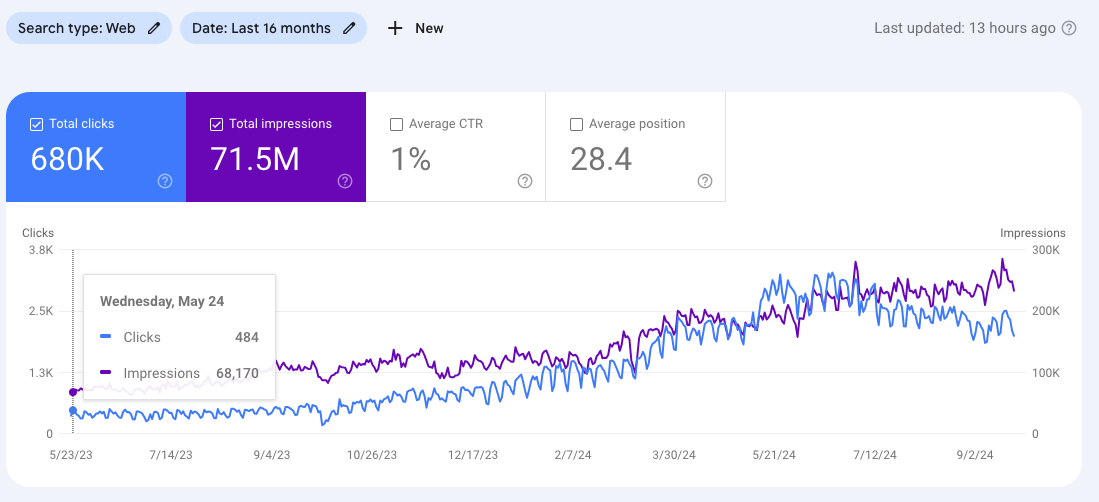
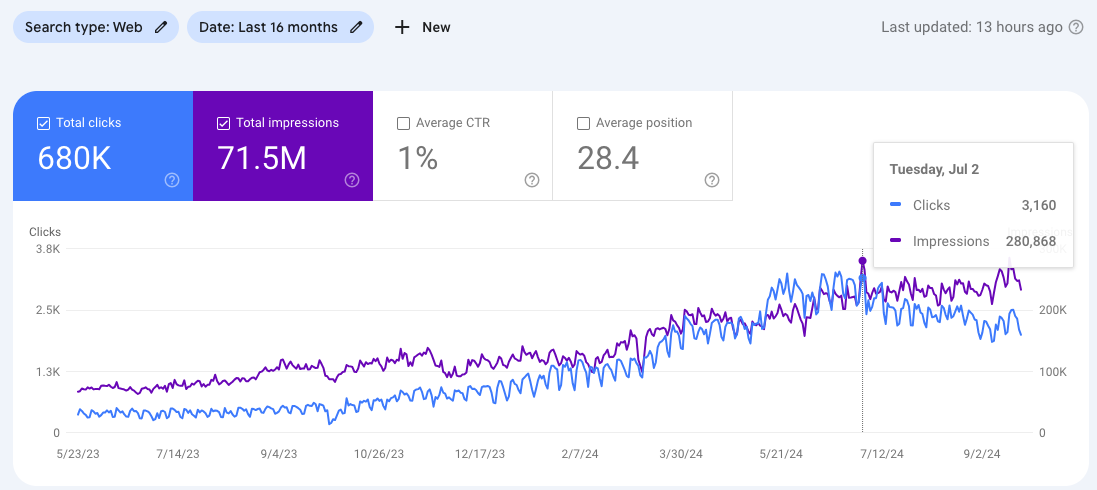
These are real numbers from Google Search Console, not projections. The firm went from near-invisible in Spanish search to ranking for hundreds of bilingual legal queries across their border city market.
680K+
Organic Clicks
Real visits from people searching for legal services in English and Spanish. None from paid ads.
71.5M+
Total Impressions
The firm’s pages appeared in Google results 71.5 million times across English and Spanish queries.
500%
Traffic Growth
From 484 clicks on a single day in May 2023 to 3,160 clicks per day by July 2024.
The Data
Before and After Google Search Console
Both screenshots show the same 16-month GSC window. The difference is the starting point: May 2023 on the left, July 2024 on the right. Same timeframe. Different trajectory.
Before May 2023
484clicks / day (sample)
68,170impressions / day (sample)
28.4avg. position
After July 2024
3,160clicks / day (sample)
280,868impressions / day (sample)
28.4avg. position
The Process
How We Got There
The growth didn’t happen from one tactic. It came from building a bilingual SEO foundation that compounded over 16 months each layer reinforcing the next.
1
Bilingual Keyword Research (Month 1)
We researched English and Spanish legal search terms independently not as translations. Border city Spanish has its own vocabulary: “abogado de accidentes,” “abogado de inmigración Laredo,” “custodia de menores Texas.” These were the terms nobody else was targeting.
2
Spanish Page Architecture (Months 1–3)
We built independent Spanish-language practice area pages with their own keyword targeting, internal linking, and hreflang pairs. Not translated pages. These are SEO-optimized Spanish pages built from scratch around how Spanish-speaking clients actually search.
3
Google Business Profile Bilingual (Months 1–2)
We optimized the firm’s GBP in both languages: Spanish service descriptions, bilingual Q&A, Google Posts in Spanish and English alternating. This drove Map Pack visibility for Spanish legal queries where competition was near zero.
4
Citation Cleanup (Month 2)
We audited and corrected the firm’s listings across 40+ directories Avvo, FindLaw, Justia, Martindale, state bar directories, and local business listings. Consistent NAP data across every platform built Google’s trust in the business data.
5
Schema + Content Authority (Months 3–16)
We implemented Service, FAQPage, LegalService, and LocalBusiness schema across all pages. Then built topical authority with bilingual long-form content targeting practice area questions in both languages the kind of content that pulls AI Overview citations.
“The bilingual SEO strategy brought in clients we were missing entirely. Spanish-language legal searches had almost no competition we were first to show up, and the leads followed.”
Law Firm Client Texas Border City
About the Strategist
Who Built This
This result wasn’t from a template or a tool. It came from understanding a specific market Texas border cities and knowing how to build bilingual SEO that actually works in that market.
Written & executed by
Neffy Paredes
Founder & SEO Strategist · Marketing by Neffy
6+ years in SEO. 20+ years in marketing. Specialized in bilingual SEO for service businesses in Texas border cities: law firms, dermatology clinics, and professional services. Every strategy is built from real keyword research, not translations.
Ready to See What This Looks Like for Your Business?
Get a free SEO audit. We’ll show you exactly where you rank in English and Spanish, what your competitors are doing, and what it takes to close the gap.
Are these real numbers from Google Search Console? ↓
Yes. The screenshots in this case study are from the actual Google Search Console account for this client. 680K clicks and 71.5M impressions over 16 months, with zero ad spend. The before and after screenshots show the same 16-month window at two different points in time.
What type of law firm was this? ↓
A multi-practice law firm in a Texas border city serving both English and Spanish-speaking clients. The firm handled personal injury, immigration, and family law. The bilingual SEO strategy targeted high-intent Spanish-language searches in a market where competitors had no Spanish presence.
How long did it take to see results? ↓
Early rankings in Spanish appeared within 60 to 90 days. The major traffic growth compounded between months 3 and 16 as topical authority built and Google Business Profile visibility increased. The full transformation shown in the GSC data took 16 months of consistent work.
Can this work for a law firm in my city? ↓
It depends on your market. Border cities like Laredo, McAllen, Brownsville, and El Paso have the highest upside because Spanish-language legal search competition is near zero. Houston has more competition but a much larger market. The free audit will show you exactly what the opportunity looks like for your specific city and practice area.
Do you work with law firms only? ↓
No. This case study focuses on a law firm, but the bilingual SEO approach works for any service business near the US-Mexico border: dermatology clinics, medical practices, home services, financial advisors, and more. The opportunity is the same wherever Spanish-speaking clients are searching and competitors are English-only.
What does the free audit include? ↓
The audit covers your current English and Spanish keyword rankings, your Google Business Profile status, citation consistency across directories, competitor analysis for your city and practice area, and a summary of the fastest-path opportunities. No pitch, just data.
Contains information related to marketing campaigns of the user. These are shared with Google AdWords / Google Ads when the Google Ads and Google Analytics accounts are linked together.
90 days
__utma
ID used to identify users and sessions
2 years after last activity
__utmt
Used to monitor number of Google Analytics server requests
10 minutes
__utmb
Used to distinguish new sessions and visits. This cookie is set when the GA.js javascript library is loaded and there is no existing __utmb cookie. The cookie is updated every time data is sent to the Google Analytics server.
30 minutes after last activity
__utmc
Used only with old Urchin versions of Google Analytics and not with GA.js. Was used to distinguish between new sessions and visits at the end of a session.
End of session (browser)
__utmz
Contains information about the traffic source or campaign that directed user to the website. The cookie is set when the GA.js javascript is loaded and updated when data is sent to the Google Anaytics server
6 months after last activity
__utmv
Contains custom information set by the web developer via the _setCustomVar method in Google Analytics. This cookie is updated every time new data is sent to the Google Analytics server.
2 years after last activity
__utmx
Used to determine whether a user is included in an A / B or Multivariate test.
18 months
_ga
ID used to identify users
2 years
_gali
Used by Google Analytics to determine which links on a page are being clicked
30 seconds
_ga_
ID used to identify users
2 years
_gid
ID used to identify users for 24 hours after last activity
24 hours
_gat
Used to monitor number of Google Analytics server requests when using Google Tag Manager